
Every AI prompt, streamed video, cloud application and online transaction relies on data centres. As demand for these digital services continues to grow, particularly with the rapid adoption of AI, so too does the need for data centre capacity.
To keep these digital services running, data centre operators have one main imperative: maintaining 99.999% uptime. Grid operators, on the other hand, have one primary focus: keeping the power system operating in real time, 24/7. Most of the time these objectives go hand in hand. But as more data centres have connected to the grid, some unplanned and unexpected interactions have come to light in how the two systems respond to short-duration grid faults.
In this article, we explore why this challenge has emerged, how fault ride through (FRT) provides a solution, and why it is quickly becoming one of the most important design considerations for modern data centres.
Protecting the workload at all costs
Data centres operate around the clock, often supporting critical digital services where even brief outages can disrupt payments, healthcare, transport and communications, while costing organisations millions, or even billions, of pounds. So, naturally, engineers have spent decades designing equipment and facilities to keep those services running, even if the power fails.
IT equipment is designed to run on continuous, reliable power, with the data centre infrastructure cleaning and supporting that power to keep the applications running. Traditionally, if a problem with the power to the building was detected, the data centre’s uninterruptible power supply (UPS) would immediately transfer the IT load onto batteries or on-site backup generation until grid conditions returned to normal. In simple terms, when a fault occurred on the grid, the data centre temporarily removed its demand to protect the digital services it was supporting.
Thanks to grid operators, most of these faults were very short, with automated systems clearing the issue within seconds. In response, data centres would detect that the grid operator had corrected the issue and quickly return from battery power to normal power drawn from the grid.
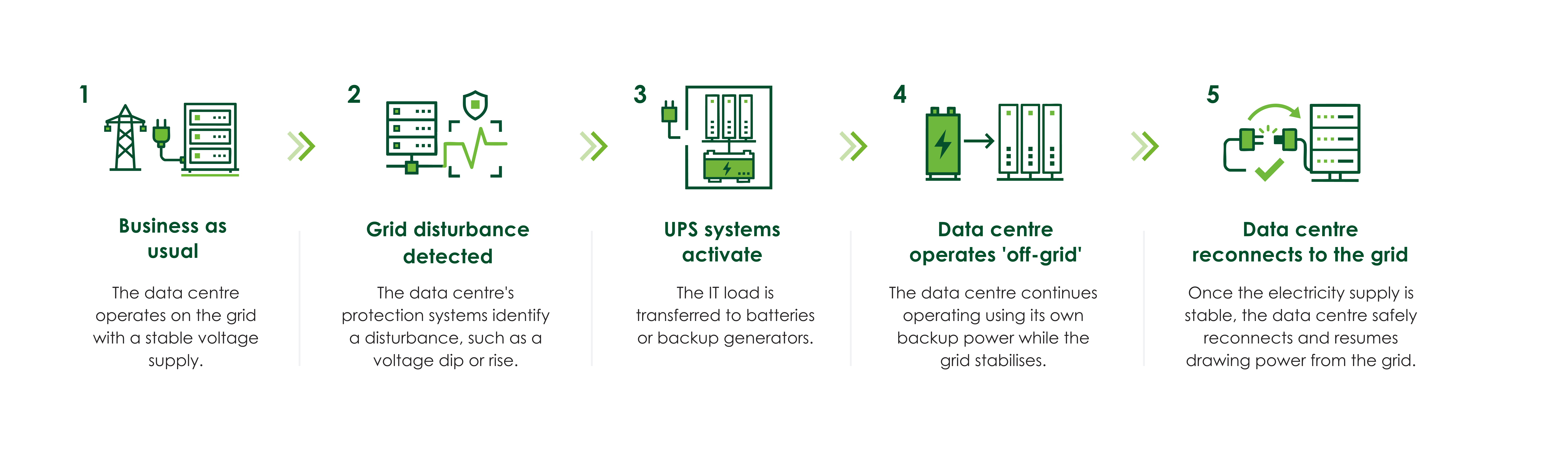
Before fault ride through, data centres typically disconnected from the grid during voltage disturbances to protect critical IT workloads.
For a single data centre, this approach isn’t usually a problem. But when dozens of facilities all respond in the same way, something much more significant happens. Many megawatts, or even gigawatts of demand can disappear simultaneously, all triggered by the same event.
To protect the grid, operators must act quickly to reduce generation and correct this sudden supply-demand imbalance. Once they have corrected both the initial fault and the loss of demand, the data centres detect that the grid problem has been resolved and reconnect. This return of demand then leaves the grid short of generation capacity and out of balance once again.
If operators cannot respond quickly enough, voltage and frequency can move outside safe operating limits, increasing the risk of cascading failures and, in the worst-case scenario, widespread blackouts.
Supporting a growing digital economy
Growing demand for AI and digital services is driving the need for more data centre capacity. According to the International Energy Agency (IEA), global electricity consumption from data centres is expected to almost double to around 945 TWh by 2030, equivalent to just under 3% of total global electricity demand. While that figure may not seem particularly large on a global scale, data centres aren’t spread evenly across the globe. Instead, they cluster in locations with abundant power, strong connectivity, and large customer demand.
The Republic of Ireland is one example. In 2025, data centres accounted for 23% of the country’s metered electricity consumption. The state of Virginia presents another. Home to the world’s largest concentration of data centres, it has become the highest-consuming state in the US for data centre electricity demand, reaching 24 TWh/year. In regions like these, having multiple facilities disconnect simultaneously presents a system-level risk.
A near miss for the grid
In July 2024, around 60 data centres in Northern Virginia, representing approximately 1,500 MW of demand, disconnected from the grid almost simultaneously following a voltage disturbance. Their load remained offline for hours while operators worked to restore normal conditions, forcing the grid operator to take emergency action to prevent wider disruption.
It was widely viewed as a warning. Then, exactly two years later, in July 2026 history repeated itself on an even larger scale. More than 3 GW of demand disconnected almost simultaneously following another voltage event. Although the original disturbance lasted only milliseconds, the grid reportedly took around ten minutes to stabilise. Voltage disturbances were recorded across a vast area stretching from Washington D.C. to Chicago and, while no formal blackouts occurred, customers reported flickering lights and electrical disturbances.
Enter fault ride through
One of the main jobs of grid operators is to keep the lights on. Literally. So, it’s good to know they’re not just sitting idly by. Around the world, they’re beginning to apply the same connection requirements to large electricity users, including data centres, as already apply to other large grid users such as power stations. One of the most important is fault ride through.
In principle, it’s quite simple. Rather than automatically disconnecting when a voltage or frequency disturbance occurs, facilities are expected to remain connected and continue operating through the event, provided it remains within defined limits. As a result, data centres remain connected to the grid, preventing large blocks of demand from suddenly disappearing, helping grid operators maintain system stability while allowing data centres to continue protecting their critical workloads.
The Republic of Ireland is among the countries leading this transition. Under EirGrid’s updated grid code, large demand customers, including data centres, are expected to remain connected during a range of voltage and frequency problems that occur on the transmission system, reducing the likelihood that local faults escalate into wider grid events.
Easier said than done
The requirement may sound straightforward, but achieving it is anything but. Data centres used to be designed with the focus of protecting IT equipment from grid events, without any provision for supporting grid stability. This was because data centres used to be small compared to the very large power grid, which was expected to remain stable, much in the same way you don’t phone a power station before turning on your toaster. Today, however, data centres can represent hundreds of megawatts, or even gigawatts, of demand, meaning their behaviour during grid disturbances can have a much greater impact on the wider electricity system. But making data centres grid-supporting takes more than simply updating a grid code document. There’s work to be done.
Much of the capability is expected to come from updating the UPS systems serving both IT and mechanical infrastructure. Major equipment manufacturers are already updating hardware and control software so facilities can remain connected during short disturbances rather than automatically transferring away from the grid. But UPS systems are only part of the equation. Engineers also need to understand how loads not protected by a UPS, including chillers, pumps and other mechanical systems, behave during faults. Compliance therefore becomes a whole-system design challenge rather than simply replacing one piece of equipment.
Building data centres for a changing grid
Following major blackouts, including those experienced across Spain and Portugal, grid operators and the public have seen first-hand the impact of grid failures on a modern, connected society and how important it is for all grid participants to play their part in keeping the grid stable. As power systems move from steam and spinning metal into a modern world with diverse and distributed generating assets, and electricity demand from AI data centres continues to accelerate, FRT is becoming a requirement set by grid operators world-wide.
At GreenScale, we believe maintaining grid stability requires collaboration across the industry. That’s why we’re working closely with our partners and equipment manufacturers to support the sector as it adapts to these changing requirements. We’ll be sharing more as part of a wider industry initiative in the coming months. Watch this space!