
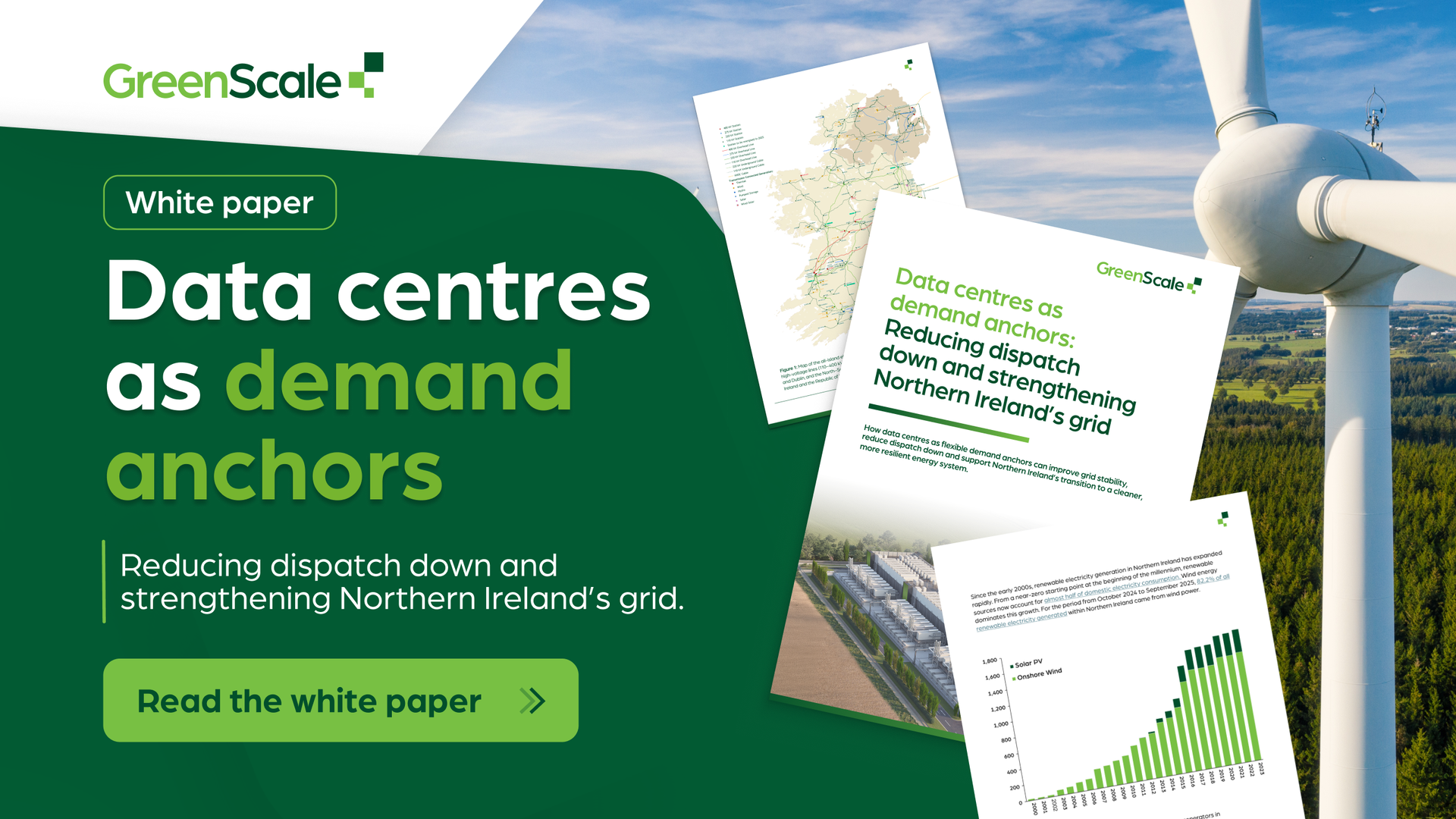
How data centres as flexible demand anchors can improve grid stability, reduce dispatch down and support Northern Ireland’s transition to a cleaner, more resilient energy system.
About
This white paper examines the interaction between grid infrastructure, renewable generation, and emerging large-scale electricity demand. It explores how data centres can act as flexible demand anchors to support Northern Ireland’s transition to a cleaner, more resilient energy system.
The analysis draws on dispatch down data, transmission system constraints, renewable generation patterns, and projected energy demand growth from data centres across Europe. It places particular emphasis on Northern Ireland, where strong wind resources in the North West contrast with limited transmission capacity to major demand centres.
The report also considers wider European trends, including grid constraints in established data centre hubs and the increasing shift toward co-locating large electricity users with renewable energy generation.
The white paper provides a structured assessment of these system dynamics, with data centres as a central lens for understanding the relationship between electricity demand growth and renewable integration.
Key highlights

29.6%
Wind dispatch down rate in Northern Ireland in 2024. Nearly a third of available wind generation was reduced due to grid constraints and system balancing.

£110 million per year
Potential annual savings for consumers in Northern Ireland by 2030 if the 80% renewable electricity target is achieved.

945 TWh
Projected global data centre electricity demand by 2030, expected to more than double this decade.
Executive summary
Northern Ireland is entering a critical phase in its energy transition.
While rising electricity demand from data centres is often viewed as a strain on power systems, when strategically located and designed to operate flexibly, data centres can instead be beneficial by unlocking the full potential of existing infrastructure, strengthening grid stability, and enabling greater use of renewable energy.
Northern Ireland, particularly the North West, possesses some of Europe’s strongest wind resources, yet a significant share of this energy cannot be fully utilised due to transmission constraints and system limitations. At the same time, Northern Ireland has committed to sourcing 80% of electricity consumption from renewables by 2030, a target that will require both expanded renewable generation and a power system capable of efficiently integrating that energy. Against this backdrop, large electricity users such as data centres that cooperate with the grid present a significant
opportunity.
Key takeaways
1. North West renewable energy potential not fully realised
Northern Ireland has experienced rapid growth in wind generation over the past two decades, with wind now accounting for the majority of renewable electricity production. However, much of the strongest wind resource is located in the North West, where local electricity demand is low and transmission capacity to other demand centres is limited. When renewable energy cannot reach demand centres, generation is reduced and the system relies more on conventional sources to meet demand. In Ireland, where there is limited alternative low-carbon flexibility such as battery storage, hydro, or nuclear, the grid must rely on gas generation as the source of stability. This raises costs for consumers and slows progress toward climate targets.
2. Large flexible demand can help unlock potential
Data centres, which require significant and reliable electricity supply, can act as valuable demand anchors in regions with strong renewable resources. When located close to generation, they can make use of renewable energy that might otherwise be curtailed, reduce pressure on constrained transmission infrastructure, and provide long-term, predictable demand that gives renewable projects the financial certainty needed to secure investment and proceed. System Operator for Northern Ireland (SONI) has recognised this opportunity, noting that large flexible demand in the West of Northern Ireland should be considered as part of wider policy solutions.
3. The North West is a strategic location for future data centre development
Across Europe, data centre development is now moving beyond traditional hubs, including Frankfurt, London, Amsterdam, Paris, and Dublin (FLAP-D) where grid congestion limits further expansion. Developers are increasingly seeking locations with strong energy availability and faster connection timelines. The North West of Northern Ireland offers a combination of strong renewable resources, available land, and the potential to support new electricity demand that strengthens the grid rather than adding pressure to already constrained urban networks. The North West will also benefit in return from increased investment, job creation, and wider economic activity associated with data centre development.
Read the full white paper to see how aligning data centre demand with renewable generation could unlock a more efficient and resilient energy system for Northern Ireland.
Quotes
“This white paper highlights a growing mismatch between where renewable energy is generated and where demand is located. Northern Ireland has made strong progress in expanding wind capacity, but system constraints mean a significant proportion of that clean energy is still being curtailed. Without addressing this imbalance, we risk limiting the full value of our renewable resources and slowing progress toward our 2030 clean energy ambitions. Aligning data centres with renewable-rich regions presents a practical opportunity to improve grid efficiency, reduce waste, and unlock the full potential of the energy system.”
– Brian Doherty, Managing Director of Northern Ireland, GreenScale
“Rather than placing additional strain on the electricity system, large electricity users have the potential to act as demand anchors, helping to better align electricity demand with available generation. In doing so, they can support a cleaner, more efficient and more resilient electricity network, improve the utilisation of existing infrastructure, and contribute to a more balanced and stable system overall.”
– Anna Dowson, Senior Director of Sustainability, GreenScale