
At the recent Data Centre LIVE: London Summit 2026, GreenScale’s CTO Jean-François Berche joined industry leaders for The AI Data Centre Debate, a panel discussion examining how AI is reshaping data centre development.
The discussion covered everything from power availability and site selection to planning, sustainability, and infrastructure design. Among the topics explored was water utilisation, an area that continues to attract attention as demand for AI infrastructure grows.
During the discussion, Jean-François reflected on how cooling systems have evolved over recent years and the role closed-loop systems now play in modern data centre design, explaining:
“Data centres fixed the water utilisation problem years ago. Nobody stops their car every 20 miles to add water to the engine, because we now have closed-loop cooling systems. That’s what we do in data centres.”
– Jean-François Berche, CTO, GreenScale
Cooling approaches and water use
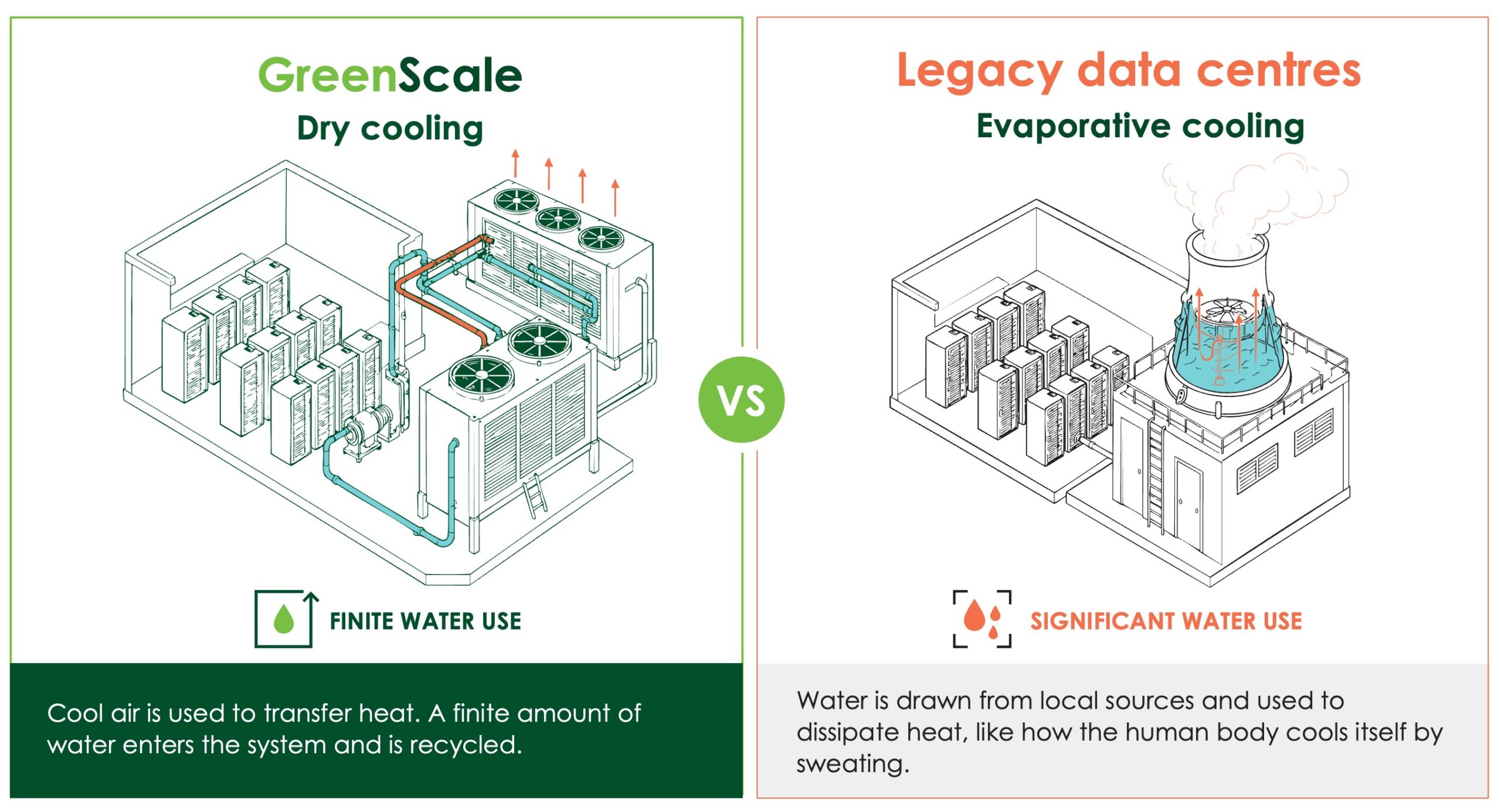
Legacy data centres often relied on evaporative cooling, where water was used to dissipate heat, like how the human body cools itself by sweating. While effective, this approach required significant volumes of water, which is particularly concerning in water-stressed regions.
Our facilities primarily use dry cooling systems that rely on cool air to dissipate heat. Where water is needed, it is contained within closed-loop systems, where it is continuously recirculated and reused. This approach is designed to reduce reliance on local water resources while supporting the performance requirements of modern data centre environments.
As demand for AI infrastructure continues to grow, the data centre industry has a responsibility to engage openly with the public about how modern facilities operate. By explaining innovations such as dry cooling and closed-loop systems, we can help build greater understanding of sustainable data centre design and support constructive conversations about the future of AI and the infrastructure needed to power it.
At GreenScale, reducing water use forms part of our broader sustainability strategy. We have committed to achieving a Water Usage Effectiveness (WUE) score of 0.4 or below within 12 months of operations across our developments through a combination of dry cooling, closed-loop systems, and rainwater capture.
To read more of Jean-François’s perspectives, along with the wider discussion from The AI Data Centre Debate, see the full Data Centre LIVE feature in AI Magazine.